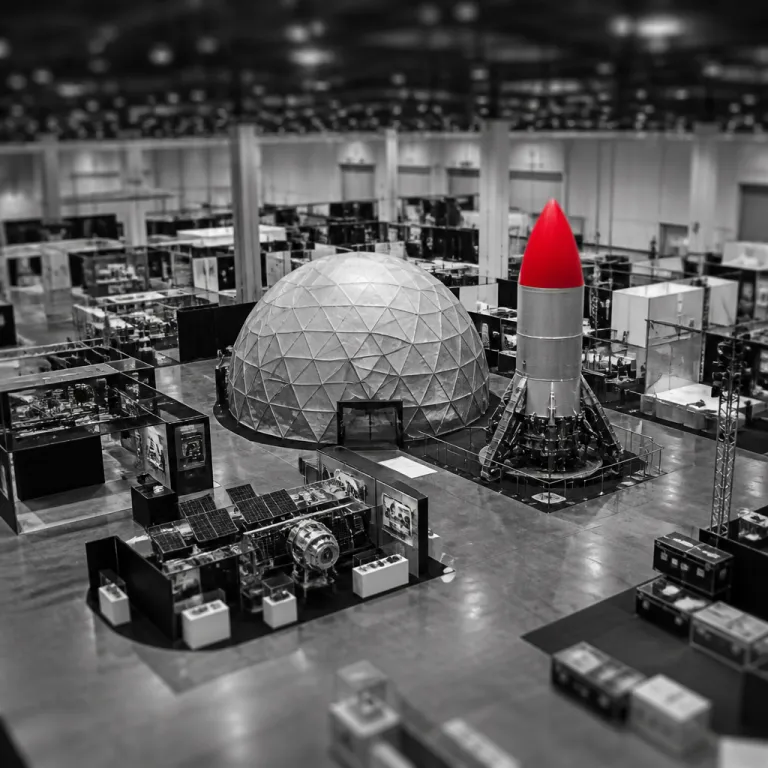
宇宙共創パビリオンが示す新たなB2Bフィールド
CEATEC 2026 Transformation 宇宙パビリオン is being positioned as a concrete B2B field for space related business rather than a symbolic showcase. Over four days at Makuhari Messe in Chiba, the organiser curated pavilion will function as a starting point where satellite operators, component manufacturers, and digital platforms from Japan and overseas test real business scenarios with enterprise buyers. For CIO and CDO level visitors, this dedicated space is less about spectacle and more about evaluating which space data and hardware software stacks can be integrated into existing information systems within a realistic time frame.
The space co creation pavilion sits inside the broader CEATEC theme of “Transformation -企業が、産業が、そして社会が変わる-” and connects directly to X(Transformation)Park and the next generation park. This spatial layout turns the pavilion into a bridge between deep tech in orbit and urban infrastructure on the ground, including mobility, logistics, and smart city environments that require precise GPS and resilient networks. For B2B decision makers, the key question is how these environments can support mission critical operations, from disaster response to predictive maintenance, without creating difficult integration bottlenecks or unmanageable security risks.
Exhibitor data from the previous edition, with 810 companies and organisations and 98,884 visitors from 29 countries and regions, is documented in the official CEATEC 2023 post event report published by the Japan Electronics and Information Technology Industries Association (JEITA). That report confirms that CEATEC already operates at the scale of a major innovation exhibition and highlights concrete collaboration outcomes. The new space pavilion is expected to attract a mix of large primes, trading houses, and 宇宙関連スタートアップ such as Synspective, ispace, and Astroscale, which have already used CEATEC to secure funding and accelerate technology development. In one documented case, the CEATEC organiser report notes how 「宇宙技術を持つスタートアップがCEATECで投資家と出会い、資金調達に成功。」という事例が紹介されている, and similar examples are cited for companies like Synspective and Astroscale, which underlines why procurement and corporate venture teams will keep CEATEC on their trade fair calendar as a serious deal making venue.
宇宙×モビリティ×エレクトロニクスが交差する商談シナリオ設計
The simultaneous staging of CEATEC 2026 Transformation 宇宙パビリオン and Japan Mobility Show Bizweek at the same Makuhari Messe venue creates an unusually dense cross industry field for B2B trade. Instead of treating space as a distant domain, automotive, logistics, and infrastructure players can run real scenarios that link in vehicle sensors, high precision GPS, and satellite communications to build new urban services. For example, a mobility OEM can start from the space co creation area as a starting point, then walk to X(Transformation)Park to validate how hardware software combinations for edge computing and AI analytics perform in crowded urban environments.
For CIO and CDO visitors, the best use of time is to pre map target exhibitors across both events and design a route that mirrors their own transformation roadmap. Linking CEATEC’s innovation exhibition zones with mobility suppliers allows them to test end to end solutions, including data platforms, cybersecurity layers, and integration partners, rather than evaluating isolated products. This approach mirrors lessons from other international trade fairs where media and technology converged, as analysed in this report on the evolution of B2B trade fairs for Japan’s media and tech industry, and it helps avoid the difficult pattern of fragmented pilot projects that never scale.
Space related exhibitors in the pavilion will not only present satellites and launch services but also building blocks for terrestrial applications such as precision agriculture, maritime tracking, and urban planning. These solutions depend on robust combinations of hardware software, from sensors to cloud platforms, and require clear support models that enterprise buyers can evaluate on site. In a typical scenario, a satellite data analytics vendor might sit down with a logistics operator to design a proof of concept that combines AIS tracking, weather data, and fleet telematics to reduce port congestion. A concrete example could be a six month POC in which the vendor, the operator’s IT department, and a systems integrator agree on KPIs such as a 10 percent reduction in average dwell time and a measurable improvement in on time departures, with monthly checkpoints during CEATEC follow up meetings. For many Japanese corporates, the 宇宙共創パビリオン will serve as a life pavilion of sorts, where they can test how space data might extend the life cycle of existing assets and services rather than forcing a risky greenfield rebuild.
CIO・CDOのためのCEATEC回遊戦略と情報収集の起点
For IT and DX leaders, CEATEC 2026 Transformation 宇宙パビリオン is less a one off attraction and more a structured starting point for long term transformation programs. The most effective teams arrive with a clear hypothesis about where space based data, GPS augmentation, and edge computing can plug into their current architecture, then use the pavilion to validate technical feasibility and vendor maturity in real time. In this sense, the curated space becomes a practical environment where a cross functional team will test assumptions about latency, data governance, and integration costs before committing to proofs of concept.
To maximise ROI, CIOs should assemble a small équipe that spans information systems, business units, and corporate planning, and assign each member a specific field such as security, data platforms, or operations. This team will keep structured notes on candidate solutions, including which vendors can support Japanese language operations, which can handle regulated environments, and which offer credible roadmaps for multi year transformation. For organisations that are also rethinking their HR and leadership structures around DX, resources such as this analysis of CHRO led digital transformation governance can serve as a useful complement when turning trade fair insights into internal change programs.
CEATEC’s organisers position the 宇宙共創パビリオン as one of several 主催者企画パビリオン, alongside X(Transformation)Park and the next generation park, to ensure that visitors can move seamlessly between visionary concepts and implementable solutions. For B2B buyers, the practical filter is simple: prioritise booths and pavilions where concrete building blocks, integration roadmaps, and measurable outcomes are on the table, rather than generic slogans about innovation. As one organiser has summarised in past CEATEC materials, 「来場者には“宇宙ビジネスの現場”としてパビリオンを使い倒してほしい」, which captures the expectation that visitors will actively stress test proposals. In that sense, CEATEC 2026 Transformation 宇宙パビリオン is best approached not as a news CEATEC headline but as a working lab where you feel free to stress test vendors, challenge assumptions, and choose events by the density of serious conversations, not by the number of booths.